Samsung Hw S801D Honest Review — Is the Hype Justified?
Introduction
I've been using the Samsung Hw S801D for several months now, and I wanted to share a detailed, honest take on whether the hype around this soundbar is deserved. I bought this unit because I was looking for a step up from my previous compact soundbar — something that could finally give movies real depth without taking over my living room. What I found was a mostly impressive package: a polished design, useful features, and a sound profile that often punches above its size. At the same time, there are a few compromises that mattered to me in daily use.
Unboxing and Initial Setup
Out of the box I noticed the S801D leans into simplicity: the main bar, a wireless subwoofer, a compact remote, and a short set of cables. The packaging was tidy and everything felt well protected. Setup took me under 20 minutes from unboxing to a working system.
In my experience, the easiest way to connect it was via HDMI ARC/eARC with my TV — once connected the TV recognized the soundbar quickly and the sound came through right away. I also paired my phone over Bluetooth and tried the optical connection for a secondary TV in another room. The soundbar has a small learning curve if you want to get the best from it, because the room calibration and sound modes make a real difference depending on placement.
Design and Build
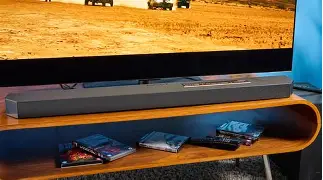
Design-wise, I appreciated that Samsung kept things understated. The S801D is not a showpiece, and that was a positive for my living room — it blends with a modern TV stand without looking bulky. The metal grille across the front looks premium and hides the drivers neatly. The wireless subwoofer is compact enough to tuck into a corner but still has the heft to feel substantial.
One thing I liked was the remote: it's small, logical, and has a sensible layout. I noticed Samsung's remote controls the most common functions without making me reach for my phone. However, I was slightly disappointed by the display feedback on the bar itself; it's minimal and sometimes hard to read from my couch when the lighting is low. That's a minor gripe, but worth mentioning if you value clear status indicators.
Sound Performance — Movies, Music, and Everyday Use
After testing the S801D across a range of content — streaming movies, live sports, rock albums, and classical recordings — several patterns became clear.
Movies and Dolby Atmos / Height Effects
One of the main reasons I upgraded was to get a more cinematic experience. In my experience, the S801D does deliver a wider soundstage than my previous soundbar. Explosions and directional effects in action scenes felt more immersive, and the separation between foreground dialogue and background ambience was noticeably improved.
That said, if you're expecting the ceiling-filling, theatrical Atmos effect you get from a full 7.1.4 system, that's not what this form factor produces. I was pleasantly surprised by how it created a sense of height on select Atmos mixes — particularly in scenes with pronounced overhead effects — but the sensations were subtle rather than overt. For many movies this lends a convincing lift, but in very complex mixes you can tell it's still a soundbar trying hard to emulate height rather than creating physically separated overhead channels.
Dialogue Clarity
Dialogue is where I saw real, practical improvement. I noticed that speech came through much clearer than on my older soundbar, especially in shows where actors speak softly or there is a lot of background noise. The center imaging felt focused, so I didn't have to crank the volume to hear conversation during crowded scenes. In my experience, this makes watching TV at late hours far more pleasant.
Shop the latest Audio & Headphones picks on Amazon.
See Deals →Music Listening
For music, the S801D is capable and enjoyable. I played a mixture of acoustic, electronic, and live recordings. Vocals were generally warm and present, and midrange details came across well. I did notice that for very critical listening — like evaluating studio mixes — the soundbar can't match bookshelf speakers or a dedicated stereo setup. But for casual to moderately serious listening, it performed admirably and made playlists sound lively.
Bass and the Subwoofer
One area I paid close attention to was bass. In my living room, the wireless subwoofer added the low-end thump that the slim main bar simply can't produce on its own. I appreciated that I could dial the subwoofer level via the remote and the app — it allowed me to tailor bass to the room and the content. For big movie moments the subwoofer delivered satisfying impact, but it did have limits: in very low-frequency-heavy scenes, it could sound a little boomy if pushed too hard. I found a balanced sub level that preserved punch without overwhelming the mids.
Sound Modes and Room Calibration
I used the soundbar's built-in presets (movie, music, voice) regularly, and they were useful starting points. What made the biggest difference was the automatic room calibration. After running the calibration a few times from different seating positions I noticed improved clarity and better-balanced bass. In my experience, that calibration is worth doing — it noticeably reduced bass boominess in my layout and tightened up imaging.
Connectivity and Features
The S801D offers the essentials and a few thoughtful extras. I used HDMI ARC/eARC most of the time and kept Bluetooth as my p…One thing that bothered me was that some advanced features are fiddly to access unless you have the right TV or the companion app open. If you want to tweak EQ while watching, it's faster through the app than the remote, which meant occasionally getting up to my phone or tablet. I also noticed that the network-based streaming features depend on the TV and app ecosystem — if you rely on third-party streaming from a device, you might not get the full set of integrated conveniences.
Reliability and Everyday Use
After several months of daily use, the S801D has been stable. I experienced only a couple of minor hiccups: once the Bluetooth pairing failed to reconnect automatically (a quick power cycle fixed it), and once a firmware update took slightly longer than expected. Overall the system felt mature and reliable — power up has been consistent and the bar has integrated well with my TV's power controls so everything turns on and off smoothly.
Pros & Cons
- Pros:
- Immersive soundstage for a single-bar soundbar — movies feel more cinematic.
- Clear dialogue and focused center imaging — excellent for TV shows and speech-heavy content.
- Compact wireless subwoofer with adjustable levels — adds satisfying low end without dominating the room.
- Polished, understated design that blends into living rooms easily.
- Useful room calibration and sound presets that meaningfully improve playback.
- Reliable day-to-day performance and straightforward HDMI connectivity.
- Cons:
- Height/Atmos effects are present but subtle — not a replacement for a multi-speaker overhead setup.
- On-bar display is minimal and sometimes hard to read from a distance.
- Advanced features and tweaks are easier to access in the app than via the remote.
- Subwoofer can become boomy if over-boosted in small rooms without careful tuning.
- Not the best option for audiophiles seeking critical stereo fidelity.
Comparison — How the S801D Stacks Up
I think a short comparison helps put this soundbar into context. Below is a simple table that compares my impressions of the S801D with my older compact soundbar and with a compact premium soundbar I auditioned at a store. I used general labels to keep this comparison practical and relevant to buyers deciding between upgrading, sticking with a compact bar, or spending more for a compact premium unit.
| Feature | Samsung Hw S801D (my unit) | My previous compact soundbar | Compact premium soundbar (store audition) |
|---|---|---|---|
| Soundstage | Much wider and more immersive for movies | Narrower, mostly front-centric | Wide, but less bass impact without sub |
| Dialogue Clarity | Clear and focused | Muddied at low volumes | Very clear, balanced |
| Bass | Good with included subwoofer | Weak, thin | Controlled, less boomy |
| Height Effects / Atmos | Noticeable but subtle | None | Also subtle unless configured |
| Design & Build | Understated, premium-feeling | Plastic, budget-feeling | Premium, compact aesthetic |
| Ease of Use | Easy, app helpful | Very simple but limited | Easy, sometimes complex menus |
| Best for | Movie lovers who want more immersion without many speakers | Basic TV audio improvement | Design-conscious buyers wanting premium sound in a small footprint |
Buying Guide — Who Should Consider the S801D?
In my experience, whether the S801D is a good buy comes down to what you prioritize. Here are the key considerations I used when deciding to keep this unit, and they may help you decide too.
Looking for the best Audio & Headphones deals on Amazon?
Shop Amazon →Room Size and Placement
I've found the S801D works best in small-to-medium living rooms. If your room is very large or you like thumping, floor-rattling bass at high volumes, a more elaborate speaker setup or a larger subwoofer will suit you better. I placed the wireless sub in a corner and the main bar under the TV; calibration helped to tame bass reflections and improved clarity.
Primary Use: Movies vs. Music
If movies are your priority, the S801D is a strong contender: it adds cinematic width and convincing low-end impact for many films. If your focus is critical two-channel music listening, you may notice limitations compared with bookshelf speakers or a dedicated stereo amplifier. I still enjoy music on the S801D, but I know its strengths lie more with mixed media and home theater use.
Connectivity Needs
Make sure your TV supports HDMI ARC or eARC if you want the simplest setup. I used ARC and had no trouble, but some advanced formats and passthrough behaviors depend on TV compatibility. If you plan to use multiple sources, consider how you’ll switch inputs — the app and remote work well, but some users prefer a receiver for many legacy sources.
Value and Alternatives
I viewed the S801D as a mid-range upgrade: you get much of the cinematic feel without committing to separate speakers and wiring. If you're price-sensitive, compare it to lower-cost soundbars that lack a subwoofer or have smaller subwoofers. If you're willing to spend more, consider multi-speaker systems for a true Atmos experience. For me, the S801D hit a sweet spot between price, features, and simplicity.
Practical Tips If You Buy One
- Run the room calibration several times from slightly different seating positions — it will yield better results than a single pass.
- Spend time dialing the subwoofer level. Too high and you'll get boom; too low and movies will lack impact.
- Use the movie or cinema preset for films, and switch to music or a neutral mode for listening to albums.
- Keep the bar centered under the TV and avoid blocking the subwoofer vents to preserve bass quality.
- Check for firmware updates through the app when you first set it up — Samsung occasionally improves performance or fixes bugs.
Conclusion
After using the Samsung Hw S801D for several months, my verdict is straightforward: the soundbar is worthy of much of the buzz. In my experience it brings a tangible upgrade over basic soundbars, with clearer dialogue, a fuller low end courtesy of the subwoofer, and a soundstage that makes movies feel more cinematic. The height effects are present but not transformative, and audiophiles looking for ultimate fidelity or a full Atmos rig will still prefer more elaborate setups.
What I appreciated most was the balance — the S801D is easy to live with, looks good in a living room, and offers meaningful improvement without complexity. What I found disappointing were a few usability moments where the app made fine-tuning necessary, and the on-bar indicators could be more readable. Those issues didn't outweigh the benefits for me, but they're worth considering depending on your expectations.
In short: if you want a sensible, well-rounded upgrade for TV, movies, and casual music listening without the hassle of multiple speakers and complicated wiring, the S801D is a strong choice. If you're chasing the absolute peak of immersive Atmos or audiophile-grade stereo, you'll want to look toward multi-component systems. For my day-to-day viewing and listening, the S801D has been a dependable and enjoyable companion.